February 11, 2026
8 min read
How to Track Family Time: The Free Family Time Audit That Changed Everything
A simple 7-day audit to discover whether you're building the family culture you imagine—or drifting toward a future you didn't choose.
The Number That Wouldn't Leave Me Alone
I sat at my kitchen table a few months ago with a number I couldn't shake.
18%.
That's how much time I actually spent in intentional connection with my family that week.
Not logistics. Not driving them places. Not managing schedules or coordinating who needed to be where. Actual connection—conversations that mattered, moments of genuine presence, time that built something lasting.
I would have guessed 40%. Maybe 50% on a good week. We eat dinner together. We do bedtime routines. We're not an absent family.
Nope. 18%.
Here's what made my stomach drop: If I kept allocating my time this way, I knew exactly what future I was building. And it wasn't the one I imagined when I thought about what kind of dad I wanted to be.
The rest of my time? Work got the lion's share (no surprise there—it screams loudest). Logistics consumed more than I expected—grocery runs, scheduling, household management. And then there was drift—the mindless scrolling, the "just checking email" that turned into an hour, the numbing activities that felt like rest but weren't.
I wasn't failing dramatically. I was drifting quietly. And that's almost worse—because you don't notice drift until you've floated far from where you meant to be.
That's why I created the 7-Day Family Gap Finder. Not because I had it figured out, but because I needed to see clearly. And once I did, everything changed.
Why a Family Time Audit Matters (The Research + The Reality)
Most parents never track their family time. We assume we know where it goes.
We're usually wrong by 20-30%.
Research backs this up. Studies on time perception consistently show that we overestimate time spent on activities we value and underestimate time spent on activities we don't. We remember the family dinner, but we forget the 45 minutes we spent on our phones afterward while everyone scattered to separate rooms.
But here's what research doesn't capture—the emotional weight of that gap.
When you believe family is your top priority but your calendar tells a different story, something fractures inside. You feel it in the guilt that surfaces at bedtime when you realize you barely spoke to your kids beyond "Brush your teeth" and "Get your backpack." You feel it in the distance growing between you and your spouse because every conversation has become transactional.
The cruel paradox of family investment: Work gives you feedback immediately. You solve a problem, you feel productive. You send an email, you get a response. You finish a project, you see results.
But family? Family rewards you in 20 years. You won't know if you raised good humans for decades. You won't know if you built real connection until your teenager actually wants to talk to you—or doesn't.
So even parents who genuinely believe family matters most unconsciously prioritize what feels productive today over what matters most long-term.
Small decisions that seem fine in isolation:
"Just one more email before dinner"
"We'll do game night next week"
"I can wait until the kids are older to really spend time with them"
Each one rational. Each one has a good reason. But they compound.
By the time the consequences become visible—distant teenagers, a spouse who feels like a stranger—it's too late to course-correct.
That's why tracking matters. Not to shame yourself. Not to optimize every minute. But to see clearly whether your daily choices align with who you want to become.
Because you can't change what you can't see.
How to Track Your Family Time: The 7-Day Gap Finder (Step-by-Step)
The family time audit I use is simple. Five minutes a day for seven days. On day eight, you'll have a conversation with your family that could change your trajectory.
Here's exactly how it works:
Step 1: Track for 7 Days
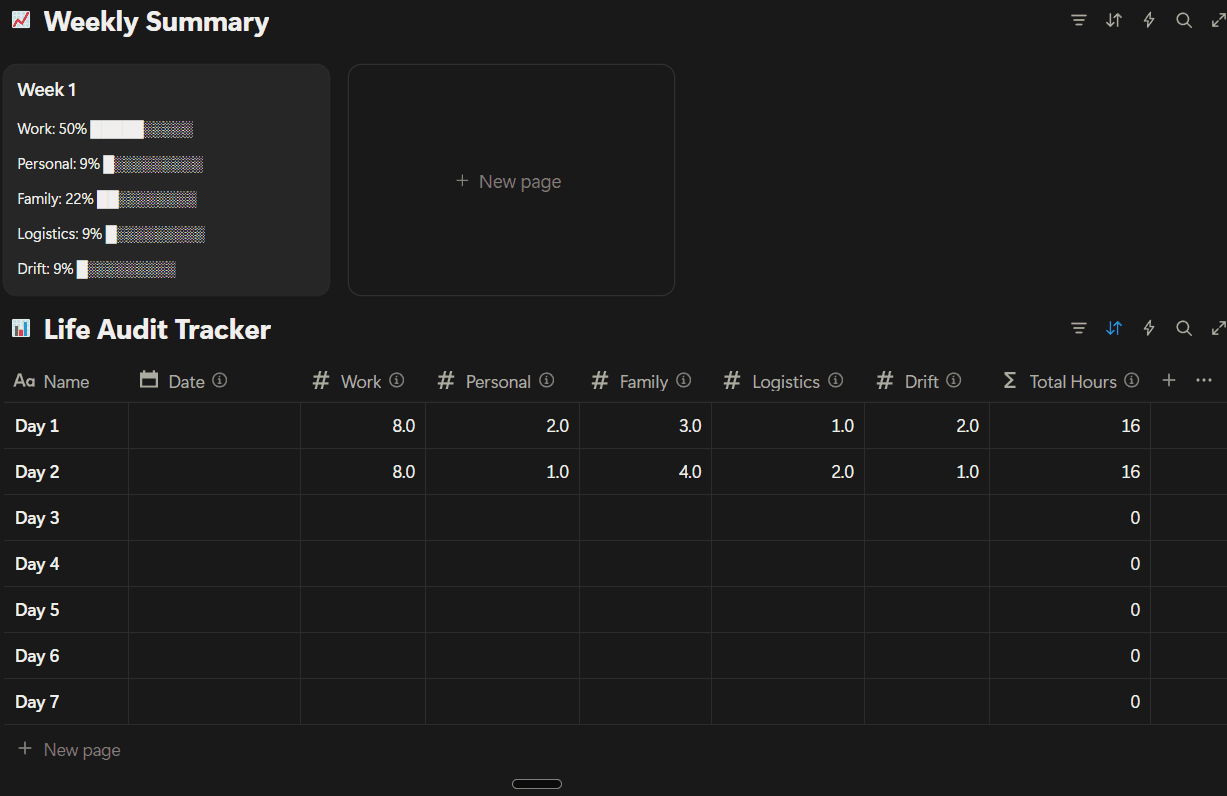
At the end of each day, estimate hours spent in five categories:
Work: Paid employment, professional development, job-related tasks.
Family Time: Intentional connection—real conversations, meals where you're actually present, activities you do together. Not logistics disguised as togetherness.
Personal Goals: Your growth—reading, hobbies, fitness, side projects. The things that make you you beyond being a parent.
Logistics: Managing the household—chores, errands, scheduling, the mental load of keeping everything running.
Drift: Unconscious scrolling, numbing activities without intention. Not rest (rest is valuable). Drift is the time that disappears without purpose.
Pro tip: Track energy levels too. Note whether you felt High, Medium, or Low energy in each area. You might discover you're giving your best hours to work and your exhausted scraps to family.
Step 2: Establish Your Values Baseline
Before you analyze the data, answer honestly:
Rank these from 1-5 (1 = most important):
Career success and professional growth
Deep, meaningful family relationships
Personal growth and pursuing my own goals
Efficiently managing household logistics
Rest and margin in my schedule
Then estimate: If you were allocating time based on your values, what should it look like? Write down ideal percentages for each category. They should total 100%.
This baseline is crucial. It shows you what you say matters most.
Step 3: Calculate Your Actual Allocation
After seven days, add up your totals. Assume roughly 112 waking hours per week (16 hours awake × 7 days).
Calculate the percentage each category received:
Total hours in category ÷ 112 = Your actual percentage
[Screenshot placeholder: Gap Analysis table showing Ideal % vs. Actual % vs. Gap for each category]
Step 4: See the Gap
Compare your ideal percentages to your actual percentages.
Ask yourself:
Which category has the biggest gap?
What am I saying 'yes' to that's pushing out what matters most?
If I keep allocating time this way, who will I become in 10 years?
That last question is the one that changed everything for me. Not who I want to become. Who I'm actually becoming based on where my resources are going right now.
Step 5: Choose Three Micro-Adjustments
You don't need to overhaul your life. You need three small experiments that move you toward alignment.
Consider:
Personal Boundaries: Changes to your schedule
Example: "No work email after 6pm"
Example: "20-minute morning walk before family wakes up"
Family Rituals: New things you do together
Example: "Sunday morning pancakes + weekly planning"
Example: "Wednesday game night (no phones)"
Make It Visible: Let your kids see your goals
Example: "Post my reading goal on fridge; update weekly"
Example: "Share my weekly focus at dinner"
Choose at least one adjustment that involves your family or makes your growth visible to them. This is the bridge between personal change and family culture.
What the Data Usually Reveals (Common Patterns)
After helping families use this audit, I've noticed consistent patterns:
Pattern 1: Logistics masquerading as family time. Many parents count driving kids to activities, helping with homework, and managing schedules as "family time." It's not. It's logistics. Important, but different from connection.
Pattern 2: Drift stealing personal goals. The time you think you don't have for exercise, reading, or creative projects? It often exists—buried in scrolling and numbing activities that feel like rest but aren't.
Pattern 3: Work getting the best hours. You give your focused morning energy to your job. Family gets whatever's left at 7pm when you're running on fumes. Your kids don't get the best version of you. They get the tired version.
Pattern 4: The invisible gap between intention and reality. The gap isn't usually dramatic. It's 10% here, 15% there. Enough to explain why things feel slightly off, but not enough to demand immediate attention.
Pattern 5: Personal growth completely abandoned. Parents often score 0-5% on personal goals. They've convinced themselves it's temporary—"I'll pursue my dreams when the kids are older." But modeling growth matters. Your kids need to see you becoming, not just managing.
How to Close the Gap: The Family Alignment System
Seeing the gap is step one. Closing it requires something more: a system that makes your values visible and keeps you accountable.
That's why I built the Family Alignment System around four principles:
Clarity: Know what matters most. See where time actually goes—not where you think it goes.
Commitment: Follow through—and let your kids see it. Model persistence, not just demand it.
Connection: Conversations that go deeper than logistics. Witness each other's becoming.
Celebration: Acknowledge progress before arrival. Make long-term investments feel meaningful now.
The audit gives you Clarity. But Clarity alone doesn't transform your family. You need the rhythms, tools, and accountability to close the gap consistently.
Day 8: The Conversation That Changes Everything
The audit isn't complete until you share what you learned.
Why this matters: Your kids learn more from watching you notice a problem and fix it than from you being perfect.
Here's the conversation:
Start with vulnerability: "I tracked my time this week and here's what surprised me..."
Pick 1-2 insights. Be honest. Something like: "I thought I was spending quality time with you guys, but most of our time together was just logistics and rushing."
Ask for their perspective: "What have YOU noticed about our family time lately?"
Listen without defending. Their perception is the reality you're building.
Name your change: "Here's one thing I'm making differently. Will you help me notice?"
Make it observable. Give them permission to hold you accountable.
This conversation models self-awareness, vulnerability, and growth. It shows your family that you're paying attention—and that what you build together matters more than being right.
Frequently Asked Questions About Family Time Audits
How accurate does my tracking need to be?
Rough estimates work fine. The goal isn't precision—it's pattern recognition. Whether you spent 12 or 14 hours on work matters less than seeing that work consistently crowds out connection.
What if my spouse isn't interested in tracking?
Start with yourself. Your transformation will speak louder than any invitation. Often, when one parent starts making changes, the other gets curious.
What counts as "intentional" family time?
Ask yourself: Was I present? Were we connecting, or just co-existing in the same space? Family dinner where everyone's on their phones isn't intentional. A 15-minute conversation at bedtime might be.
What if the results make me feel guilty?
Guilt isn't the goal. Clarity is. You can't change yesterday, but you can change tomorrow. The gap you see is information, not condemnation. Use it to build something better.
How often should I do this audit?
Quarterly works well. Enough time for patterns to emerge, frequent enough to course-correct before drift compounds.
Your Turn: Start the Family Time Audit Today
Most parents never see the gap until it's too late to close it.
You can see it now.
The 7-Day Family Gap Finder shows you where your time actually goes—then helps you have the conversation that changes your family's trajectory.
It takes 5 minutes a day. On day 8, you'll have Clarity. And Clarity is the foundation everything else is built on.
Download the free 7-Day Reality Check →
Because you can't build the family you imagine if you can't see the one you're currently creating.
Ready to go deeper? The Family Alignment System provides the complete framework—weekly rhythms, goal tracking, and family check-ins that turn this one-time audit into lasting transformation. Learn more about the Family Alignment System →
Related Resources:
Align Your Family
Build a family your kids will want to replicate
Stay Connected
Join the Community
© 2026 Align Your Family. All rights reserved.
Privacy Policy
Terms of Service