March 4, 2026
6 min read
When January rolls around, intentional parents will spend hours creating a family vision board full of ideas, pictures, and goals.
And like clockwork, when February comes, no one looks at them anymore.
The vision board doesn't fail because someone picks the wrong photos. It fails because a collage of images isn't a system. It's a snapshot of hope with no infrastructure behind it.
If you've been searching for family vision board ideas, I want to offer you something more useful: a real framework for making your family's goals visible in a way that actually changes how you spend your time together.
Because that's what you're really after, isn't it? Not a prettier board. A family that's genuinely moving toward something — together.
Why Traditional Family Vision Boards Stop Working
The idea behind a family vision board is sound. Visualization works. Making goals visible matters. Research consistently shows that people who write down and display their goals are more likely to achieve them.
So why do most family vision boards end up as decoration?
Three reasons:
They're aspirational, not directional. A photo of a beach vacation tells you where you want to go, not what you need to do differently this Tuesday. There's no bridge between the image and daily behavior.
They're static. A poster board can't reflect progress. It looks exactly the same whether you're drifting or thriving. There's no feedback loop, no sense of movement, no reason to keep looking at it.
They belong to parents, not the whole family. Most family vision boards are made by parents, for parents. Kids tolerate them. They don't feel ownership over them. And when kids don't own it, it becomes wallpaper within weeks.
The families I've observed make real progress — the ones building something they're genuinely proud of — aren't using prettier vision boards. They're using systems that make goals alive, not just visible.
What "Making Goals Visible" Actually Means
There's a difference between goals being posted and goals being present.
Posted goals live on a wall. Present goals live in conversation. They get mentioned at dinner. Kids ask about them. Parents model pursuing them in plain sight.
When I tracked how my family actually spent our time together, I discovered we were operating almost entirely in logistics mode — schedules, homework, meals, screens. The goals we said we cared about? They existed on paper, not in our daily rhythm.
Making goals truly visible means building them into the infrastructure of your family life, not just your decor.
Here's what that looks like in practice.
5 Family Vision Board Ideas That Actually Create Momentum
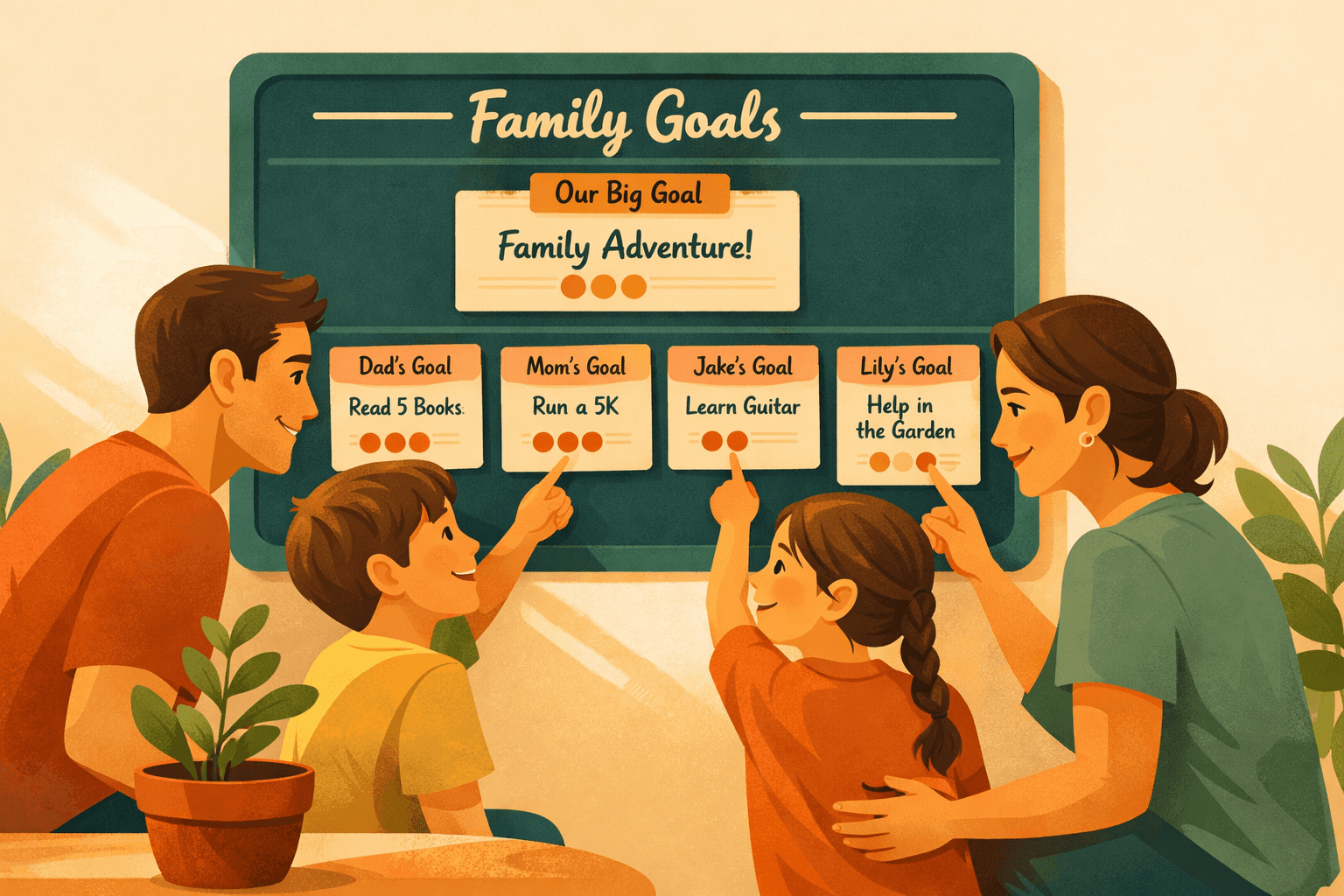
1. The Family Goals Dashboard (Digital + Physical)
Instead of a static poster, create a living dashboard your family interacts with regularly.
This can be as simple as a whiteboard divided into sections — one for each family member's current focus, plus a shared family goal. What makes it work isn't the format; it's the habit of updating it weekly and referring to it in conversation.
The key shift: it's not just displayed — it's discussed. Every Sunday, spend five minutes asking: What did we each work on this week? What's one thing we want to move forward next week?
Goals stay alive when they're talked about. When your 8-year-old knows you're working on writing a book, and you know they're working on making the soccer team, something shifts. You're not just sharing a house. You're sharing a pursuit.
2. The "Progress Wall" (Celebrate the Journey, Not Just the Destination)
Most families only celebrate arrivals — the finished project, the grade, the win. But the journey from intention to outcome is where character actually forms.
A progress wall tracks the showing up, not just the finishing. It might be a simple jar where family members drop in a note whenever they worked toward their goal that week. It might be a habit tracker posted on the fridge. It might be a shared journal where you each record one moment of effort.
The point is to make progress visible. When your kids can look at a jar full of notes and think "we've been working toward this for two months," they develop something no vision board can give them: evidence of their own persistence.
3. Individual + Family Goal Pairing
Here's where most family vision boards miss: they focus entirely on family experiences (trips, traditions, time together) and ignore personal growth.
The most connected families I know are ones where parents make their own goals visible to their children — not just the family collective ones.
When your kids see you pursuing something hard, struggling with it, persisting anyway — that's more formative than any motivational speech. They're not watching for your success. They're watching to see what you do when it's difficult.
A powerful structure: each person in the family (yes, including young kids) has one personal goal and one way they're contributing to a shared family goal. Both are visible. Both get talked about.
4. The "Why" Board (Values, Not Just Wishes)
The problem with most vision boards isn't the what — it's the absence of the why.
A family that has "take a trip to Italy" on their board has a wish. A family that has "we value exploring the world together because it teaches us that people everywhere have more in common than different" has a value, and from that value, Italy becomes one of a hundred possible expressions.
Before you choose images or goals, spend time as a family on the question: What do we want to be known for? Not what do we want to have. What do we want to be.
When goals are rooted in values, they survive the chaos of real family life. When they're just wishes, they get crowded out by everything else competing for your attention.
5. The Quarterly Reset Ritual
A vision board made once a year captures who you were in January. But families grow. Kids change. Circumstances shift.
The families who stay aligned, who actually become the family they set out to be, treat their goals as a living document, not a sealed time capsule.
A quarterly reset (four times a year, about 30-45 minutes) asks: What still fits? What have we outgrown? What new thing is calling us? What progress deserves to be celebrated before we move on?
This ritual does something profound: it teaches your kids that goals aren't all-or-nothing. They're directional. You're allowed to adjust. What matters is that you stay intentional, that you keep asking the question rather than drifting on autopilot.
The Deeper Problem Most Vision Boards Don't Solve
For most families, the gap isn't between where you are and where you want to be.
The gap is between what you say matters and how you actually spend your time.
Most families assume they're investing significantly in what they value. When they actually track it — the intentional connection, the meaningful conversations, the shared pursuit of something — the number is almost always smaller than they imagined.
A vision board can't close that gap. A system can.
A system makes your values actionable. It creates the daily and weekly rhythms that translate intention into reality. It builds in the visibility, accountability, and celebration that keep families moving together, not just existing in the same house.
What Thriving Families Do Differently
They don't have better vision boards. They have better infrastructure.
They've built clarity (everyone knows what everyone is working toward), commitment (there are rhythms and rituals that make it real), connection (goals are talked about and witnessed, not just posted), and celebration (progress gets noticed before it becomes achievement).
These four things — Clarity, Commitment, Connection, Celebration — are the difference between a family that says it values something and a family that actually builds its life around it.
A vision board, done well, can be a beautiful expression of Clarity. But without the other three, it remains a wish board.
Where to Start
If you want to move beyond the poster board and build something that actually works, here's a simple first step:
Sit down as a family this week (even for just 15 minutes) and ask three questions:
What's one thing each of us is working toward right now?
What does our family want to build or experience together in the next 90 days?
How will we know we're making progress?
Write the answers down. Put them somewhere everyone can see. Commit to bringing them up once a week.
That's not a vision board. That's the beginning of a family culture.
If you want a complete system for doing this — templates, a weekly rhythm, and a way to make your family goals visible in a way that actually sticks — the Family Alignment System gives you the infrastructure to turn intention into reality.
Because your family doesn't need more inspiration. It needs a system that makes the invisible visible.
Leo Rule writes about building family culture at Align Your Family. He helps intentional parents close the gap between the family they imagine and the family they're actually building.
Align Your Family
Build a family your kids will want to replicate
Stay Connected
Join the Community
© 2026 Align Your Family. All rights reserved.
Privacy Policy
Terms of Service