February 4, 2026
6 min read
That One Tuesday
It was a Tuesday night, and we were all sitting around the dinner table. Everyone was home. Everyone was talking. But when I asked the usual questions, ”How was your day?” “What’s going on this week?” I got the usual answers.
“Fine.”
“Good.”
“Nothing really.”
I wanted more for our family, but I felt like we were just going through the motions.
We were together constantly as a family. We had meals, bedtime routines, and weekend errands, but somewhere between the activities and calendar management, I realized something that bothered me. I could name everyone’s schedules, but I couldn’t name anyone’s struggles, goals, or what they were actually excited about.
No one really knew what each family member was working toward.
The Misdiagnosis
When families start feeling like they are drifting or just going through the motions, the default assumption is often: We’re too busy, we have too many activities, and not enough margin. So we try to cut back, clear the calendar, and create more family time.
And it might help… for a little while. But the deeper problem remains.
Even with clearer schedules and more time together, priorities can still be invisible to each other.
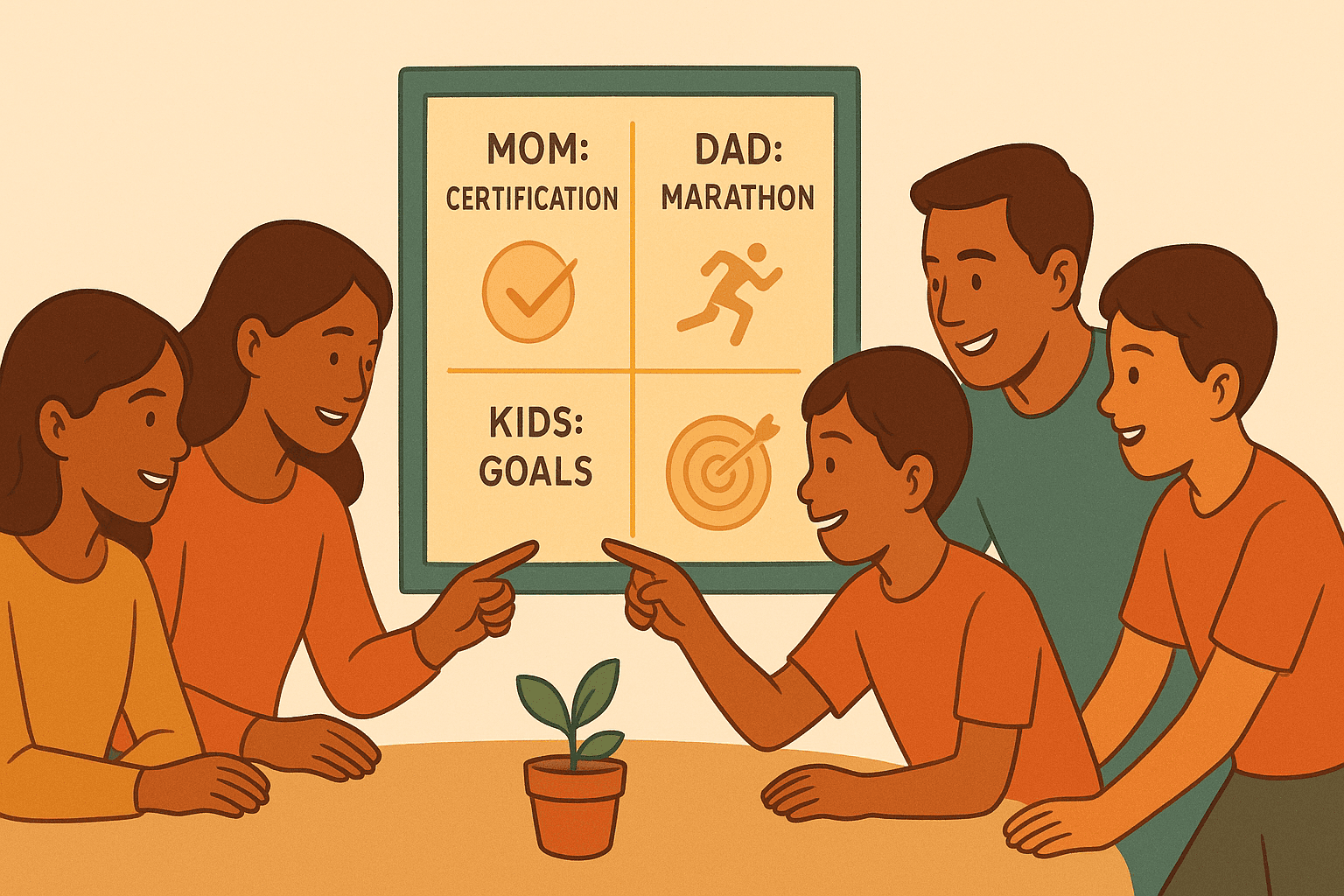
My wife was studying to take a test for a professional certification. The family knew she was “busy with work stuff,” but they didn’t understand what she was building or why it mattered to her. So when she zoned in on her laptop in the living room after dinner, they didn’t see dedication. They just saw that her attention was not on them.
I was trying to hit a marathon personal best, so I spent some time on Saturdays doing a long run. But my family just thought Dad is gone on some Saturday mornings. They had no context for what I was working on or why I kept doing it consistently.
And because we couldn’t see what the other was pursuing, we started getting frustrated and going through the motions instead of collaborating. My wife and I both felt unsupported because neither of us could articulate what the other was working toward. We assumed each person had it easier.
The takeaway for me was: You can’t support what you can’t see, and you can’t collaborate when you don’t know the mission.
When Goals Become Visible, A Lot Changes
I wanted to stop going through the motions and give our family a sense of direction. So a few months ago, I started a simple experiment. I put our family and individual goals on one shared board—nothing fancy, just a Notion page we could all see. Each person posted 1-3 things they were working on. The simple act of making our goals visible made a difference.
Competition became collaboration.
When the family could see that Mom was studying for her exam on Tuesday, they understood why we were keeping the house quieter after dinner that week. It wasn’t about them being inconvenienced. It was about supporting someone they loved through something hard.
We were reminded that success isn’t achieved individually. We can all be working toward different things AND support each other. The questions shifted from “Why do you get to do that?” to “How can I help?”
Absence became context.
When my family could see my running goal on the family board, my early mornings made sense. Being gone some Saturday mornings wasn’t rejection. It was the natural consequence of someone pursuing something difficult.
I started getting questions like “How is your running going?”
Not “Why were you gone?” Not “Why can’t you help right now?” We were tracking progress as a family. They were seeing my persistence, not just my absence.
That’s part of the shift. When goals are visible, your family stops just doing the bare minimum. They begin to understand how they can contribute to the bigger picture.
Connection happened naturally.
Once everyone knew what everyone else was working on, our conversations changed. We didn’t have to force family meetings or schedule intentional connection time.
“How’s your goal going?” became part of dinner conversations.
“I see you had three good training runs last week” became a normal acknowledgment.
And there was an unintended benefit. My family is learning what it means to be for each other, not just near each other. It helps us remember that a family is not about going through life together on individual paths. Family is an opportunity to support each other so everyone can share in success.
How to Make This Practical
You don’t need an elaborate system. I just used three simple changes.
1. Make goals visible (literally)
Pick one shared space—fridge, whiteboard, digital dashboard, whatever works for your family. Have everyone post 1-3 things they’re working on. Not tasks, but goals with a real outcome and date.
Include a timeline so progress is trackable: “Finish by June 15,” “Read 24 books this year,” “Practice piano 4 days a week.”
This isn’t about accountability so people feel bad if they don’t hit them. It’s about making invisible efforts visible so your family can support them.
2. Weekly 10-minute check-in
This isn’t a logistics planning session. You probably already do that. This is different.
Ask different questions:
“What’s one thing you’re proud you kept going with this week?”
“What’s hard right now that you’re pushing through?”
“How can we support each other this week?”
Everyone shares, everyone listens, and everyone sees the full picture.
Sunday, I was able to share, “My run was boring this week, but boring is part of what it will take to achieve this goal, so I don’t want to quit.” We got to have that conversation because we made space for it.
3. Celebrate progress, not just completion
When someone hits a milestone (even a small one) name it out loud in front of the family.
“You studied four nights in a row even though you were exhausted!”
“You practiced piano even though you didn’t feel like it!”
This teaches kids that the journey matters. Persistence counts. We notice each other’s growth, not just the finish line.
The Culture You’re Building
This isn’t about posting goals to increase productivity. It’s about creating a family where everyone knows what everyone’s building and doesn’t just go through the motions.
Before we made our goals visible, we were busy but directionless. We were coordinating schedules, not building culture or establishing values. Now, we cheer for each other’s wins. When someone’s struggling, the family rallies. We’re not just managing a household, we’re building a team.
My family is learning that family isn’t about everyone doing their own thing. It’s about the whole family unit. Family is special becasue it’s a group of people who get to learn what each person is passionate about and choose to support them.
That’s a culture they’ll want to replicate.
Start This Week
You don’t need less on your calendar. You need more visibility into what everyone is passionate about.
Try this:
Ask everyone tonight: “What’s one thing you’re working toward right now?”
Put it somewhere everyone can see
Check in next Sunday: “How’d your week go with that?”
That’s it. That’s alignment.
And when your family is aligned, busy doesn’t mean disconnected. It means you’re all building something together.
Align Your Family
Build a family your kids will want to replicate
Stay Connected
Join the Community
© 2026 Align Your Family. All rights reserved.
Privacy Policy
Terms of Service