February 4, 2026
5 min read
The Document We Never Opened
My wife and I created our family values while we were engaged.
We sat in a coffee shop one Saturday afternoon, notebooks open, debating words that felt weighty enough to anchor a future family. After much discussion, we landed on four: Worship. Wisdom. Warmth. Wonder.
We were proud of them. They felt meaningful. They captured who we wanted to become together.
Once we got married, we created artwork with the words written out beautifully, framed them, and hung them in our living room.
And then... we basically forgot about them.
Not completely. We’d glance at the frame when guests came over. Occasionally, reference them in a big decision. But day-to-day? Week-to-week? They were decorative. Background noise.
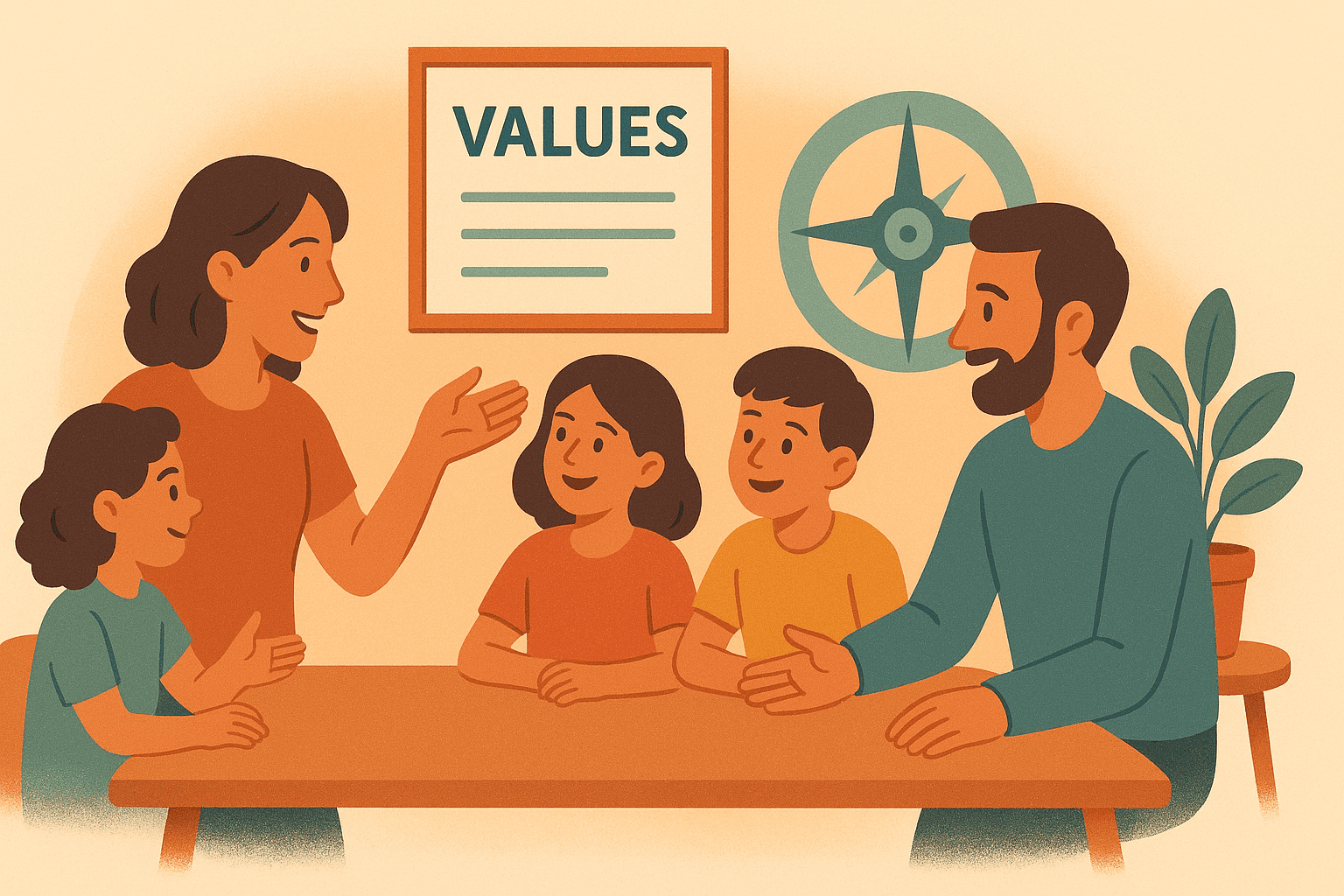
Our values lived on the wall. They didn’t live in our lives.
In this issue:
Why most family values fall short (and it’s not because they’re wrong)
The missing ingredient that makes values actually shape your family
How to choose AND activate family values that become your family’s heartbeat
Read time: 6 minutes
The Problem With Most Family Values
Having family values isn’t the hard part. Anyone can come up with a list of words. The hard part is actually living them out. Most families approach values like they approached their wedding vows—a profound declaration made once, then quietly archived in the “important documents” folder of life.
You craft them with intention. Maybe during a weekend getaway or a New Year’s planning session. You discuss what matters most. You wordsmith until they feel right. You write them down, maybe even make them visible somewhere.
And then Monday happens, that soccer practice, work deadline, and the never-ending logistics of keeping a family running.
They fall to the side, and it’s not because they are the wrong values. You just never built the infrastructure to keep them present.
Family culture isn’t created by what you say matters. It’s created by what you notice, what you name, and what you reinforce—over and over and over. If your values aren’t being talked about weekly, they’re not actually shaping anything. Instead, they’re just nice words on a wall.
The Shift That Changed Everything
Fast forward five years from that coffee shop. We have a kid. We’re in a new city. Life feels a lot different than it did then. And I started to notice we were drifting. Not in a dramatic way. Just in that quiet, unsettling way where you realize the family you’re actually building doesn’t quite match the one you imagined.
That’s when we made a simple change to our weekly family check-ins: We started talking about one value every week.
Not all four. Just one.
Week 1: Worship
Week 2: Wisdom
Week 3: Warmth
Week 4: Wonder
Repeat.
And here’s what happened:
My wife and I started bringing them up more in our day-to-day.
During dinner one night, I said, to my wife, “You embodied warmth today the way you spoke to our new friends.”
Our values had begun to move from the wall to awareness. Into our vocabulary. Into how we make sense of the world.
It revealed the reality that values don’t work by existing. They work by being activated.
Why This Is So Important
Before you can align your family on goals, before you can build meaningful rhythms, before you can create the culture you imagine—you need clarity on what actually matters. Not just productivity, efficiency, or having your act together.
You need to know what matters to YOUR family. What you stand for. What you’re building together.
Values are your compass. Without them, every decision feels arbitrary. Every goal feels disconnected. Every week feels like you’re just reacting instead of building.
But here’s the part most people miss:
Choosing values is just Step 1. The real work is making them ACTIVE in your daily life.
Because your kids won’t remember the frame on the wall. They’ll remember whether your choices reflected something consistent. Whether there was a “why” behind what you did. Whether they understood what kind of family they were part of.
How To Choose (And Actually Live) Your Family Values
Let me walk you through the exact process my wife and I used—both when we first chose our values and when we finally made them real.
Part 1: Choosing Your Values (30-60 minutes with your spouse)
Step 1: Start With Stories, Not Abstractions
Don’t begin by Googling “best family values.” Start with memories.
Ask each other:
“What’s a family moment you want our kids to remember when they’re adults?”
“When have you felt most proud of us as a family?”
“What do you want people to say about our family when we’re not in the room?”
Write down the moments that come to mind. This is all about capturing, not planning.
Step 2: Look For Patterns
Read through your stories together. What themes emerge?
Maybe your proudest moments involve learning something hard together. (That might point to Growth or Perseverance.)
Maybe they involve showing kindness to someone outside your family. (That might point to Generosity or Compassion.)
Maybe they involve creating something beautiful or having deep conversations. (That might point to Creativity or Connection.)
Circle the themes. Name them.
Step 3: Choose 3-5 Core Values
You can’t have 12 family values, or you’ll remember none of them.
Aim for 3-5, and for each value, write one sentence explaining what it specifically means in your family.
How not to do it: “We value kindness.” - Vague and unclear how to live it out
What to write instead: “We notice when people need help, and we choose to act even when it’s inconvenient.” - Clear and digestible
Step 4: Make Them Memorable
If your values are a paragraph each, you won’t remember them.
We chose single words that started with the same letter (Worship, Wisdom, Warmth, Wonder). You might choose a phrase, an acronym, or a simple list.
By the time you’re done, a 7-year-old should be able to understand and recite them.
Part 2: Making Them ACTIVE (The Part That You Can’t Skip)
This is where most families stop. They have their values, they frame them, and then nothing changes.
Here’s how to actually integrate them into your daily family life:
Weekly Activation: The One-Value Check-In
Every week during your family meeting or dinner, spotlight ONE value.
Ask these three questions:
“Where did we see [VALUE] this week?”
(Let everyone share. Even small moments count.)“Where did we miss an opportunity to live [VALUE]?”
(Model honesty here. You go first.)“How can we practice [VALUE] this coming week?”
(Pick one specific, observable way.)
Example:
This week’s value: Warmth
“Where did we see warmth this week?”
“Mom made hot chocolate when I was sad.”
“Dad helped the neighbor carry groceries.”
“Where did we miss it?”
“I yelled at my sister when she borrowed my toy without asking.”
“How can we practice it this week?”
“Let’s each do one kind thing for someone in the family without being asked.”
That’s it, it really can just be 10 minutes every week.
Rotate through your values. In four weeks, you’ve talked about each one. Over a year, you’ve reinforced them 13 times each.
Much better than the values on your wall that you mentioned once in a whole year.
It’s all about making them visible (but usable)
Yes, put them on the wall. But also:
Reference them when you notice someone living them (”That was Wisdom—you thought before you acted”)
Use them when making family decisions (”Does this align with our value of Wonder?”)
Let your kids hear you talk about them with other adults
The goal isn’t perfection. It’s presence.
Values that are part of conversations become values that shape behavior.
What This Looks Like In Real Life
Last month, my daughter was hitting new developmental milestones and exploring everything around her.
Before our values were active, I would’ve glanced over this and not given it a second thought, but because we’d been talking about Wonder that week, I stopped for a second. I realized she was living out wonder by showing incredible interest and appreciation for the things around her.
It was a small thing, but I thought about a day in the future when she is older, and we have talked about wonder that week during our family check-in. I hope it would inspire her to live with more wonder and appreciation for the things she is learning and experiencing.
That’s what active values look like. They become the voice in your kids’ heads when you’re not there. The framework they use to make sense of moments. The identity they carry with them.
Why This Matters For Family Alignment
Whether you like it or not, you become what you invest in, not just who you intend to be.
The same is true for values.
You don’t become a family defined by generosity because you said it once. You become that family because you noticed it, named it, and reinforced it—again and again.
Clarity on values is the first step in the Family Alignment System because you can’t align on a destination if you don’t know what you stand for.
Your goals should reflect your values
Your time allocation should reflect your values
Your celebrations should reflect your values
Your hard conversations should reference your values
Values are the “why” behind everything else.
Without them, you’re just optimizing for... what? Efficiency? Keeping everyone happy? Getting through the week?
With them, every decision has a reference point. Every week has a throughline. Every year compounds into a family culture that’s yours—not something you inherited or defaulted into.
Your Turn: A 30-Minute Exercise
If you’ve been nodding along thinking “I should really do this,” here’s your moment.
Tonight or this weekend, grab your spouse and spend 25 minutes on this:
Share 2-3 family moments that made you proud (5 min)
Identify the themes in those moments (5 min)
Choose 3-5 values and write one sentence for each (10 min)
Decide how you’ll make them memorable (5 min)
Then, at your next family meal, introduce them:
“We’ve been thinking about what kind of family we want to be. Not perfect. Not always easy. But intentional. And we came up with [X] values that matter to us...”
Name them. Explain what they mean in kid-friendly language.
Then ask: “Which one do you think we’re already pretty good at? Which one do we need to work on?”
Starting this Sunday: Pick ONE value to talk about at dinner.
Ask the three questions:
Where did we see it?
Where did we miss it?
How can we practice it this week?
Do that every week for a month.
The Quiet Compounding
I deeply believe this:
Families with active values drift less.
Not because they’re perfect. But because they have a compass. A shared language. A way to notice when they’re off course and course-correct together.
Our four values—Worship, Wisdom, Warmth, Wonder—they’re not magic. They’re not better than anyone else’s.
But they’ve become the heartbeat of our family. The thing we return to when life gets chaotic. The identity we’re building together, one conversation at a time.
Not on the wall, but in our lives.
Align Your Family
Build a family your kids will want to replicate
Stay Connected
Join the Community
© 2026 Align Your Family. All rights reserved.
Privacy Policy
Terms of Service