February 5, 2026
6 min read
In middle school, I asked my mom if I could quit saxophone lessons.
Not because I hated it. Not because my teacher was mean. But because I kept thinking, “The hard part isn’t fun anymore.”
I was seven weeks into learning a new instrument. Seven. And already, the novelty had worn off, and I discovered what every human learns eventually: getting good at something requires doing it when you don’t feel like it.
I think my mom wanted to say yes, that I could quit. Because she wanted me to be happy, and watching me frustrated made her sad. But I’m glad she didn’t because what would she have been teaching me if she let me walk away the second it stopped being easy?
In this week’s newsletter:
How making your goals visible helps your family build resilience
The moment I realized that modeling is more powerful than motivation
One system that’s teaching my family what we’re capable of
Let’s go!
Power of Persistance
Well over a decade later and that saxophone conversation with my mom still sticks with me.
I think about what might have happened if she said, “Okay sweetie, you can stop. It’s fine.”
Instead, in that moment, my mom was thinking about more than just the saxophone lesson. She was thinking about my future. She knew the example it would set if she let me walk away when it got hard.
My mom did more than just say I couldn’t quit. She embraced not quitting in her own life and knew what it felt like to push through when things got hard. She had not optimized her life for comfort. She didn’t live by the saying, “if it doesn’t spark joy, let it go.”
I know this because my mom went back to school and got a second degree while I was in school. She took me to countless practices and events while managing a full-time job. I’m sure there were lots of late nights and moments where she wanted to quit, but didn’t.
I continued on with saxophone lessons for several years, and it wasn’t all smooth sailing, but I came to enjoy it.
Looking back, I didn’t keep going because she told me not to quit, but a big reason was because I’d never seen her quit.
That’s the thing about kids, isn’t it? They don’t listen to your lectures about persistence. They watch what you do when your own goals get tough.
The Comfort Trap We’re All Caught In
Let’s be honest about what happens all too often.
We want to give our kids a great life. We want to make things easy for them. Give them things not everyone is blessed to have.
We want them to have: Choice. Freedom. Joy.
But somewhere along the way, “I want my kids to be happy” becomes “I’ll remove every obstacle in their path.” And now it feels like the default is to raise kids that are incredibly comfortable... and terrifyingly fragile.
Here’s the thing: Comfort and capability are inversely related.
The more you smooth the path, the weaker their legs get. The more you remove the struggle, the less they believe they can handle struggle. Challenges in life are inevitable. You know this. I know this. But do our kids know this?
More importantly, when things get hard, what example do your kids think of?
When your son hits a wall with his math homework, does he have a mental image of someone pushing through difficulty? When your daughter faces friendship drama, has she witnessed resilience in action?
We can’t protect them from hard things. But we can give them a reference point for what it looks like to face hard things and not crumble.
And family is uniquely positioned to be that reference point for each other.
What Actually Teaches Persistence
Motivation is not the key to teaching perseverance. Kids don’t need another “you can do it!” pep talk.
It’s not rewards either. Sticker charts and ice cream bribes create external dependency, not internal drive.
What teaches persistence is something much simpler and much harder:
Seeing proof that their effort matters over time.
Not immediate proof. Not instant gratification. But the slow, unglamorous evidence that showing up on day 47 when nobody’s watching actually moves the needle.
When your kids can SEE their own persistence—tracked, visible, undeniable—something shifts. They start to build an identity around follow-through. “I’m the kind of person who sticks with things” becomes part of who they are, not just what you tell them to be.
The 90-Day Test
I’ve started running an experiment in my house. I call it the 90-day test.
When someone in my family wants to start something new, we talk about three things:
What do you want to be able to do that you can’t do now?
Are you willing to work on this even when it’s not fun anymore?
Can you commit to 90 days before we decide if it’s for you?
And then we track it for 90 days. Not just the days, but also some measurable outcome. Minutes practiced, baskets made, problems solved. Maybe the goal is 1000 shots, 100 hours of practice, or 10 books read. We plan it and set it.
The 90 days is long enough to get past the excitement phase. Long enough to hit the “this is boring” wall. Long enough to experience what it feels like to be bad at something, keep going, and get slightly less bad.
Week 1-3: Novelty carries us. Everything is exciting. Progress feels fast.
Week 4-7: The slog. This is where quitting looks appealing.
Week 8-12: Something shifts. We’re not great yet, but we can see we’re better than we were. Identity starts forming: “I’m the kind of person who sticks with things.”
The interesting part. When the progress bar on the goal starts to move forward, it builds motivation. We think “two weeks ago, it was at 15% and now it’s at 45%, I got this.” Identity starts to build, and motivation snowballs.
A lot of times, we keep going after 90 days.
What I’m Learning About My Own Quitting
Here’s the uncomfortable part: I can’t teach what I don’t model.
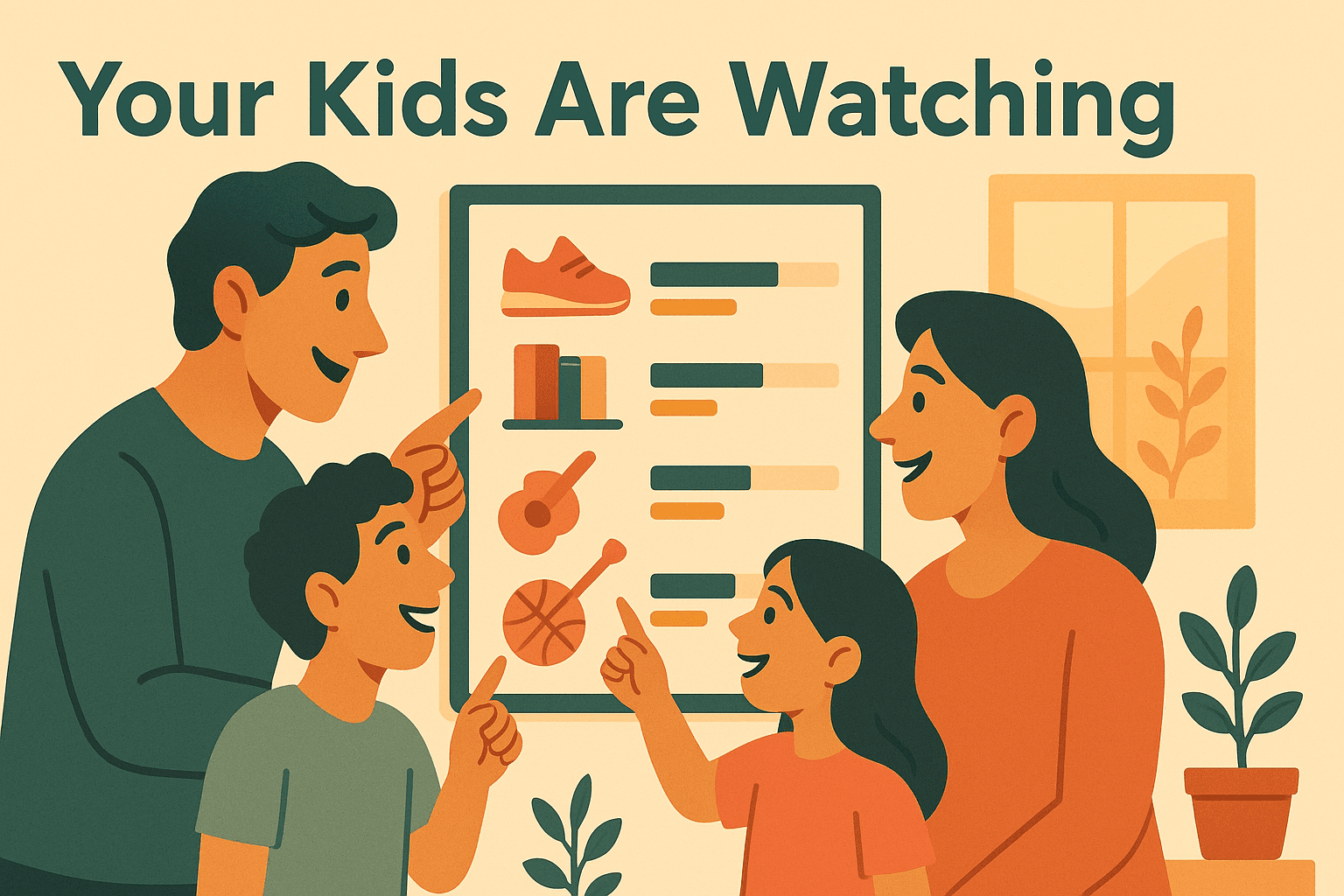
So as a family, we make all our goals visible, including myself. Not hidden in a journal or a notes app. Not tucked away in some productivity system nobody sees.
Visible. All our family goals on the same board.
My family can see:
That I’m working on running a marathon
That I’m aiming to read 24 books this year (I’ve read 20)
That last month I did not memorize the verses I had planned
They see me struggle. They see me show up anyway. I can see that my wife is also working on hard things, also hitting walls, also choosing to continue.
And here’s what I didn’t expect: it’s making us better at being a family.
Because resilience isn’t just about achieving goals. It’s about having the mental fortitude to push through relational conflicts. To restore relationships when they fracture. To put others above yourself when it’s hard—and do it with joy.
The Bigger Picture
When your family sees you complete a 90-day goal, they’re not just learning about achievement. They’re learning:
That discomfort is temporary
That their family members don’t quit on hard things
That if everyone in the family can push through challenges, everyone wins
That being a good family member sometimes means putting others first—and that’s a muscle worth building
This is bigger than saxophone lessons or reading goals. This is about cultivating a belief in your family members that they can handle whatever life throws at them. That they can navigate hard conversations. Rebuild when things break. They know, deep in their bones, that they’re capable.
The Question That Changes Everything
I believe making goals visible like this will make a real difference. Maybe one day during our family check-in, my daughter will ask me: “Dad, what did you work on this week that was hard?”
I would be so excited.
Not because I would have a great answer (I’d probably tell her about a presentation I had to rewrite multiple times). But because she asked. Because in our house, “working on hard things” has become normal and worth talking about.
That’s the shift I’m after. Not perfection or ease, but a family culture where persistence is just... what we do. For ourselves. For each other. Together.
One Thing You Can Do This Week
Make your goals visible to your entire family.
Not perfectly. Not in some Instagram-worthy command center. Just... visible.
Kids learn more from watching you navigate difficulty than from any lecture about not giving up. And when they can see their OWN progress tracked over time, they build an identity around persistence that no amount of pep talks can create.
Exactly how to start:
Pick ONE goal you’re working on (or want to work on)
Tell your family about it at dinner tonight: “I’m trying to [X] for the next 90 days”
Update them weekly: “This week was hard because...” or “This week I made progress by...”
Ask them to pick one thing they want to work on for 90 days
Check in together—make pushing through hard things a family value, not just an individual one
That’s it. You’re not asking them to be perfect. You’re showing them what follow-through looks like in real time. And you’re creating a family where resilience isn’t just talked about—it’s lived.
They’re watching anyway. Give them something worth seeing.
P.S. This whole conversation started because I built something for my own family—a way to track everyone’s goals in one place so we could actually see the progress we couldn’t feel yet.
Because here’s what I realized: We don’t need another app to organize our family. We need a way to help our kids (and ourselves) understand that we’re capable of resilience. That we can achieve whatever gets thrown at us. That when things get hard, we have examples—in each other—of what it looks like to push through.
If you’re curious about the system we use for the 90-day test and family check-ins, I’m working on opening up early access. Sign up on the waitlist, and I’ll send details when it’s ready.
Align Your Family
Build a family your kids will want to replicate
Stay Connected
Join the Community
© 2026 Align Your Family. All rights reserved.
Privacy Policy
Terms of Service