February 17, 2026
5 min read
How to Build a Weekly Family Rhythm That Doesn't Feel Forced
You've probably tried this before.
Sunday evening, full of optimism, you gather the family for a "weekly meeting." You've got a notebook. Maybe some questions you found online. Everyone sits down, and for about three weeks... it works.
Then soccer season starts. Or someone has a birthday party. Or frankly, everyone just stops showing up because it felt like another obligation stacked on top of an already packed week.
The meeting dies. The rhythm never forms. And you're left wondering if your family just isn't the "intentional planning type."
Here's what I've learned after years of trying (and failing) to create consistent family rhythms: The problem isn't your family. It's that most family meeting approaches rely entirely on your energy and memory to make them work. When life gets busy—and it always gets busy—willpower runs out first.
What actually works is infrastructure. A repeatable template that does the heavy lifting for you, so showing up each week feels less like launching a rocket and more like following a trail that's already been cleared.
Why Most Family Rhythms Fail
Think about the last time you tried to establish a regular family check-in. What happened?
For most families, it goes something like this: Week one is great. Everyone's engaged. Week two, you remember at 8pm that you forgot to plan anything. Week three, someone has a conflict. By week four, it's been so long since the last meeting that restarting feels awkward.
The pattern reveals an important truth: families don't fail at rhythm because they don't care. They fail because they're trying to recreate the wheel every single week.
Each time you sit down, you have to remember what to talk about, figure out how to make it meaningful, recall what everyone said they were working on last time, and somehow make the whole thing engaging enough that people want to come back.
That's exhausting. No wonder it doesn't stick.
The Infrastructure That Changes Everything
What if your weekly family time had a template that automatically reminded you what each person achieved that week? What if gratitude and goals weren't things you had to remember to discuss, but prompts that were already there waiting for you?
This is what I mean by infrastructure. A system that captures wins, surfaces gratitude, tracks goals, and prepares everything before you even sit down.
When the template does the remembering, you get to do the connecting.
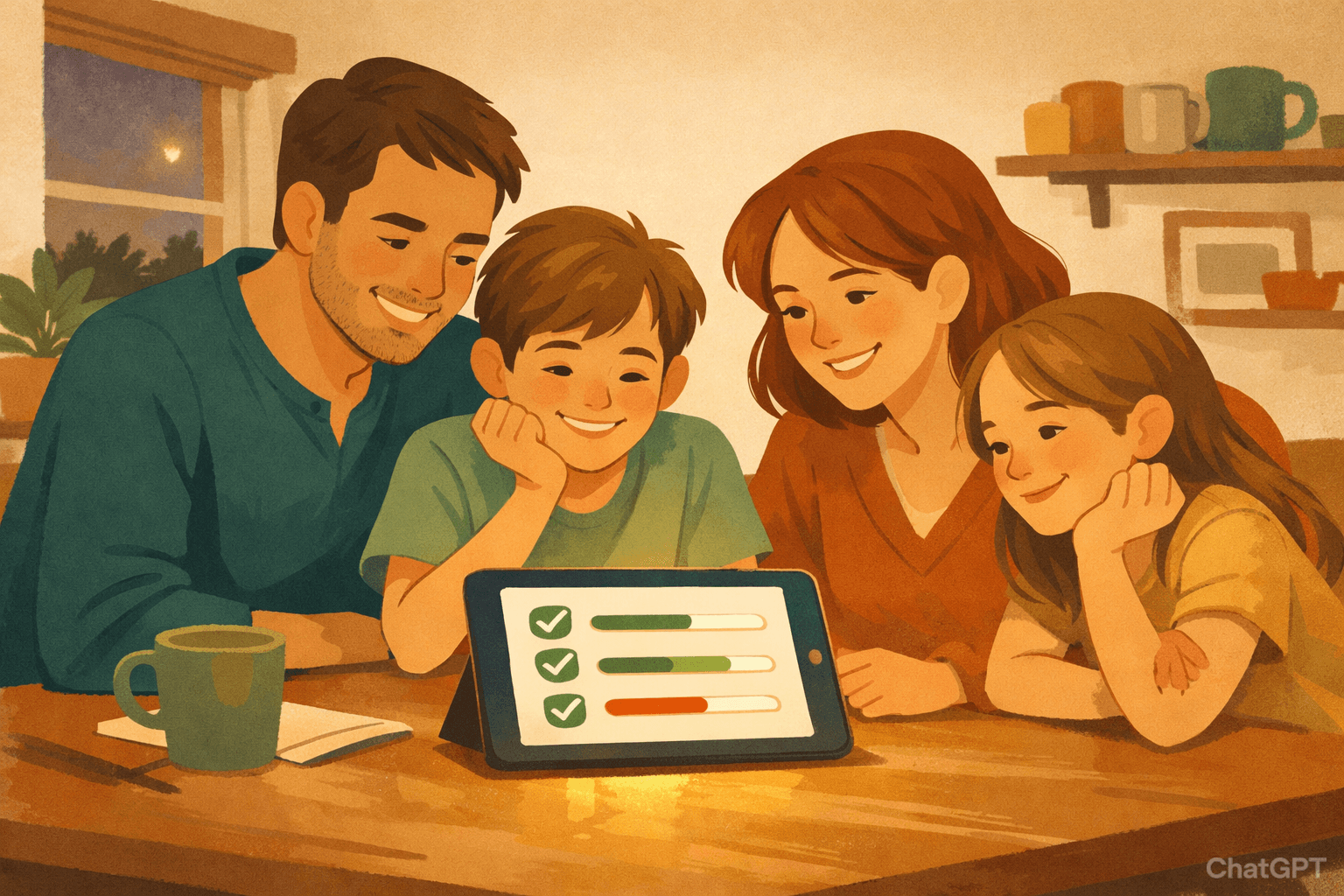
The difference is profound. Instead of asking "So... what should we talk about?" you're looking at a dashboard that shows: Dad finished his certification course this week. Mom hit her exercise goal three days in a row. Your daughter finally nailed that piano piece she's been practicing.
Now the conversation isn't forced. It's obvious. "Hey, I see you finished that course—how does it feel?" The connection happens naturally because the visibility is built in.
The 4 C's: A Framework for Rhythms That Stick
After testing dozens of approaches with my own family, I've found that sustainable family rhythms need to hit four elements every single week. I call them the 4 C's: Clarity, Commitment, Connection, and Celebration.
Clarity means everyone knows what the family is working toward—not just this week, but in the bigger picture. It's answering the question: "What matters most to us right now?"
Commitment is about making your persistence visible. When your kids see that you set a goal last week and you're still working on it this week, they learn that words mean something. They watch you model what it looks like to keep going.
Connection moves conversations beyond logistics. It's not just "Did you finish your homework?" but "What was the hardest part of your week?" and "What are you most grateful for?" These questions require a different kind of presence.
Celebration is acknowledging progress before arrival. Most families only celebrate when goals are complete—the graduation, the championship, the promotion. But the research is clear: recognizing effort along the way is what builds the motivation to continue.
A weekly rhythm that hits all four of these doesn't feel like a chore. It feels like the highlight of the week.
What This Looks Like in Practice
Here's how a template-driven family rhythm actually works:
Throughout the week, each family member logs small things as they happen. A goal they made progress on. Something they're grateful for. A challenge they're facing. This takes seconds—a quick note when it's fresh.
By the time Sunday arrives, the template has automatically collected everything. You sit down and it's all there: what everyone accomplished, what they're thankful for, what they're working on next.
The conversation practically runs itself.
"I see you practiced piano four times this week—that's more than last week. How's it feeling?"
"Dad, you said you were grateful for the quiet morning on Tuesday. What happened?"
"Mom finished her project at work. Should we do something to celebrate?"
This isn't a meeting. It's a moment of genuine connection that happens to be structured enough to repeat every single week.
The Honest Truth About Building Rhythm
I need to be straight with you: even with the right infrastructure, establishing any rhythm takes time.
The first few weeks will feel clunky. People will forget to log their wins. Someone will be cranky. You'll wonder if it's worth the effort.
Keep going.
Around week four or five, something shifts. The kids start asking "When are we doing our family time?" Your spouse mentions something during the week and says "I'll add that to our check-in." The rhythm starts to feel less like something you do and more like who you are.
By week eight or ten, you'll look back and realize: your family has a culture now. A shared language. A weekly anchor that keeps everyone oriented in the same direction.
That transformation is worth the awkward beginning.
The Compound Effect of Weekly Visibility
Here's what most families miss: the power of a weekly rhythm isn't in any single week. It's in the compound effect of doing it consistently over months and years.
After six months of weekly check-ins, you have a record of what everyone's been working toward. You can see patterns: your son always loses motivation in March. Your daughter thrives when she has creative goals. Your spouse needs more rest than they're getting.
After a year, your family has a shared history of growth. Not just memories, but documented proof that you're becoming something together. You can look back and say "Remember when you were struggling with that, and now look at you."
This kind of visibility transforms family culture. It proves that daily choices align with long-term values. It shows your kids that their family is going somewhere—not just surviving until they leave.
Getting Started
If you're ready to build a weekly family rhythm that actually sticks, here's where to start:
First, accept that the infrastructure matters more than the inspiration. Stop trying to wing it each week. Get a system that does the remembering for you.
Second, commit to hitting all 4 C's: Clarity, Commitment, Connection, and Celebration. If your weekly time only covers logistics, it will eventually feel like just another obligation.
Third, give it eight weeks before you evaluate. Real rhythms take time to establish. The awkward phase is normal and temporary.
The families who stop drifting and start moving together aren't more motivated than you. They just have better infrastructure.
And with the right system, any family can build a weekly rhythm that transforms how they connect.
Ready to build your family's weekly rhythm?
The Family Alignment System gives you the exact template we use—complete with automatic tracking for wins, gratitude, and goals. Everything populates before you sit down, so you can focus on connecting instead of coordinating.
Get the Family Alignment System
Leo Rule is the founder of Align Your Family, where he helps intentional parents build family cultures their kids will want to replicate. His work is built on one insight: families don't have productivity problems—they have visibility problems. When everyone can see what everyone's working toward, everything changes.
Align Your Family
Build a family your kids will want to replicate
Stay Connected
Join the Community
© 2026 Align Your Family. All rights reserved.
Privacy Policy
Terms of Service