March 25, 2026
6 min read
family-vision-boardMost families have a vague sense of what they want. They want more connection. Less chaos. Kids who care about something beyond the next screen time window. But when it comes to actually sitting down and setting goals together? It usually goes one of two ways.
Either it never happens — because it feels too formal, too scheduled, too much like work. Or it happens once, generates a lot of enthusiasm, and then like sticky notes falling off the wall, nobody mentions it again.
This post is about the third option: a family goal-setting process that's honest about what actually works, calibrated to the ages in your home, and rooted in connection rather than productivity.
Why Most Family Goal Setting Falls Flat
Before we talk about what works, it's worth naming why it usually doesn't.
It's parent-driven, not family-driven. When Mom or Dad shows up with a whiteboard and a pre-filled agenda, kids comply. They don't invest. The goals become your goals that they're tolerating.
It aims for outcomes instead of direction. "Get better grades" and "eat healthier" are outcomes. They're also unmotivating because they don't tell anyone why it matters or what kind of family you're trying to become. Goals without direction are just pressure.
It happens once a year and never gets revisited. A goal that lives on a piece of paper in January but never comes up again isn't a goal. It's a wish with formatting.
It skips the most important question. Before anyone sets a goal, someone needs to ask: What do we actually want our family to feel like? Most goal-setting processes start with what to accomplish. The best ones start with who you want to be.
What Changes Things: Direction Before Destination
Here's the reframe that makes family goal-setting work: stop thinking about goals as destinations and start thinking about them as direction.
A destination is "take one family trip this year." A direction is "we're a family that explores new places together." The first gives you a checklist item. The second gives you a lens for decision-making all year long, and something your kids can actually internalize.
When kids know the direction, they can participate in choosing the path. That's the difference between a child who completes a chore because they were told to and one who does it because they understand they're contributing to something real.
The question to start with isn't "What do we want to accomplish?" It's "What kind of family do we want to be?"
From that foundation, goals become the natural next step, not an assignment.
Family Goal Setting By Age: What Actually Works
One of the biggest mistakes parents make is applying the same goal-setting framework to a 6-year-old and a 14-year-old. Kids engage with goals completely differently depending on where they are developmentally. Here's a practical breakdown.
Ages 3–6: Anchor to Feelings, Not Outcomes
Any parent knows young children don't think in future time horizons, they live in the present. Goal setting for this age isn't about outcomes at all. It's about helping them recognize and name the feeling of a good day.
What works: Simple, visual, feeling-based conversations. Ask "what makes our family feel happy?" and let them draw it. Make a picture together of what a good family week looks like. Celebrate small, repeated wins ("we had dinner together four times this week").
What to avoid: Abstract future goals, anything that requires delayed gratification over more than a few days, tying goals to rewards in a way that makes connection feel transactional.
The goal at this stage: Build a felt sense that your family does things intentionally and on purpose. The specifics don't matter much. The feeling does.
Ages 7–11: One Word, One Focus
Elementary-age kids can think about the future, but they thrive with simplicity and clarity. A framework that works well here: one word, one focus, one win per week.
Ask each child: If you could pick one word that describes what you want to get better at this year, what would it be? Kids this age come up with answers that surprise you — "brave," "kind," "patient," "creative." That word becomes their thread for the year.
From that word, identify one concrete focus area: maybe "brave" means trying one new thing per month. Maybe "kind" means a weekly act of service. The word provides meaning; the focus provides traction.
Then, at your weekly family check-in, each person shares one win connected to their word. This is low-pressure, high-meaning, and builds the habit of goal awareness without the weight of outcome tracking.
What to avoid: Too many goals, goals that are driven by school performance anxiety, anything that creates comparison between siblings.
Ages 12–15: Give Them Agency, Then Connect It
Middle schoolers are building identity. They're asking (even if they'd never say it out loud) Who am I, and where do I belong? Goal setting at this age works best when you give them genuine ownership first and then help them connect their goals to something larger than themselves.
What works: Let them come to the conversation with their own goals already drafted. Don't show up with the framework, show up with the questions. "What do you want to be true about this year that isn't true right now?" "What's one thing you want to actually try?" "What do you want our family to do together?"
Then, as a parent, share your goals too. This is the modeling-over-managing principle in action: when a teenager sees their dad say "this year I'm working on being less reactive when I'm stressed," they understand that growth is a normal adult activity — not something you grow out of.
What to avoid: Using goal-setting as a backdoor to talk about grades, screen time, or behavior issues you've already been trying to address. Teenagers can smell an agenda from a mile away.
Ages 16–18: Treat Them Like a Collaborator
By this stage, the most powerful thing you can do is stop leading the goal conversation and start participating in it as a near-equal. Your older teen doesn't need your framework. They need your presence, your honesty, and your genuine curiosity about who they're becoming.
Ask them to help shape what the family is working on this year. Give them real ownership over one area of family life like a tradition, a service project, a rhythm they design. Let them see the family as something they're building, not just something they're in.
The goal at this stage: Leave them with the belief that being part of an intentional family is something worth carrying into their own future family someday.
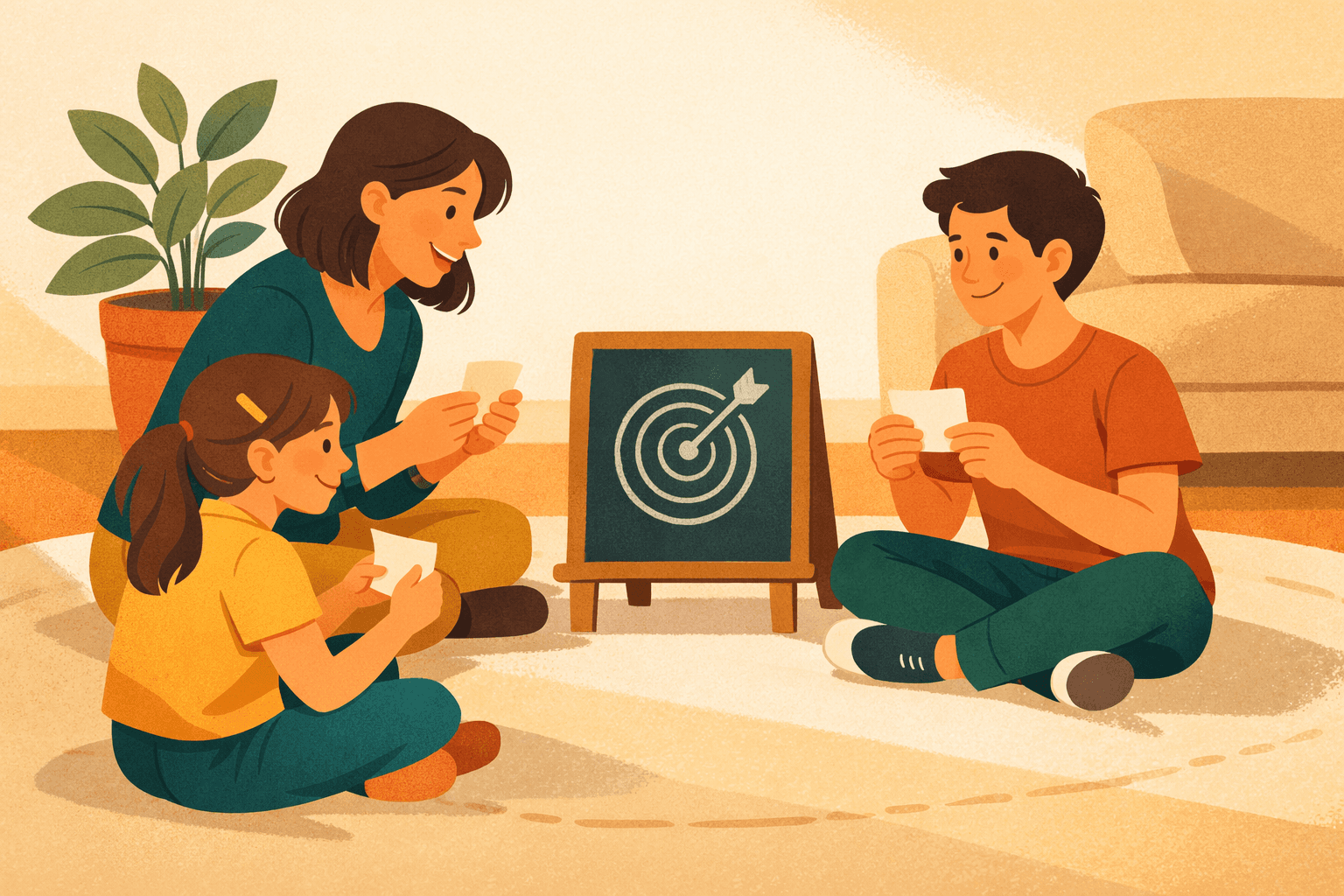
A Simple Process You Can Run Tonight
You don't need a retreat or a Saturday afternoon or a special workbook. Here's a 30-minute family goal conversation that works.
Step 1 — The look back (5 minutes). Ask: What's one thing that went well for our family this past year? What's one thing that was hard? Let everyone answer. No fixing, no defending, just listening.
Step 2 — The direction question (10 minutes). Ask: If our family had a great year, what would that look like? What would we feel? What would we be doing together? Let kids answer first. Write it down.
Step 3 — One goal each (10 minutes). Based on that direction, ask everyone — kids and parents — to name one thing they personally want to work on this year. It doesn't have to be formal. It doesn't have to be measurable. It just has to be real.
Step 4 — The family goal (5 minutes). Together, pick one thing you want to do as a family this year. One shared pursuit. Something that requires all of you. This becomes your anchor.
That's it. Revisit it briefly at your weekly family check-in. Watch it come alive over months.
Making Goals Visible (Without Turning Your House Into a Motivational Poster)
Goals that stay in people's heads don't get acted on. But you also don't need to wallpaper your kitchen with vision boards.
A few low-friction ways to keep family goals visible:
The family hub. A shared space (physical or digital) where each family member's focus for the year is written out. The Family Alignment System includes a Family Hub built specifically for this: a place where everyone's goals are visible without being performative.
The weekly check-in question. One question per week, rotating: How did you move toward your goal this week? It doesn't require a long answer. Just the habit of noticing.
Celebration over correction. When someone makes progress toward a goal — even small progress — name it out loud. "I noticed you practiced that this week." Recognition from a parent at this age lands differently than any external reward.
The Question Your Kids Are Actually Asking
When you sit down to set goals as a family, your kids aren't just learning about goal setting. They're watching to see whether you believe your family is going somewhere.
Whether you treat these conversations as an obligation or an investment. Whether you show up with your own goals or only ask about theirs. Whether this is something you do once and forget or something that shows up in small ways all year.
The goal-setting process itself is a signal. Done well, it tells your kids: this family is intentional. We're building something together. And you matter to what we become.
That's worth 30 minutes on a Sunday evening.
Related posts:
Ready to give your family's goals a home? The Family Alignment System includes a shared Family Hub where every member's goals are visible, connected, and revisited weekly — so this year's goals don't end up on a sticky note in a drawer.
Align Your Family
Build a family your kids will want to replicate
Stay Connected
Join the Community
© 2026 Align Your Family. All rights reserved.
Privacy Policy
Terms of Service